
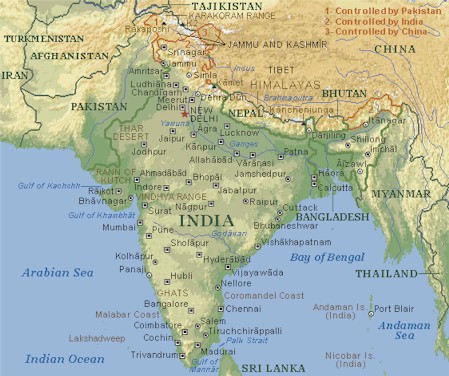
Location
India lies in southern Asia to the south of Nepal and China and to the east of Pakistan . To the south is the Bay of Bengal and the Arabian Sea. Including the areas of Jammu and Kashmir which Pakistan and India have disputed over, India has an area of 3,165,596 sq km (1,222,243 sq mi). The capital is New Delhi, but India's largest city is Mumbai, (otherwise known as Bombay).
India's Land and Resources
India may be divided into four main regions. The Himalayas, the highest mountains in the world, lie along India's northern and eastern borders. South of them is the northern river-plains region, a belt of lowlands watered by the Indus, Ganges, and Brahmaputra rivers. Further south is the Deccan, a plateau covering most of peninsular India, with low mountain ranges and deep valleys. The fourth region consists of the Eastern and Western Ghats, mountain ranges that lie on the east and west, of the Deccan Plateau. Most of India has a tropical climate. Monsoons tend to influence temperature, humidity, and precipitation in India. The seasons are classified as rainy and dry. In addition to plenty of ferile land and valuable forests, India has many mineral deposits. The plant life varies from sparse in the areas near Pakistan to very luxuriant in the southeastern part of the plains region. Arctic plants grow at high elevations inthe mountains, and the lower elevations support subtropical plant life and are densely forested. India has many differnet types of animal life, from large cats such as tigers, to elephants and rhinoceroses, and even several species of apes, antelope, and deer. .